
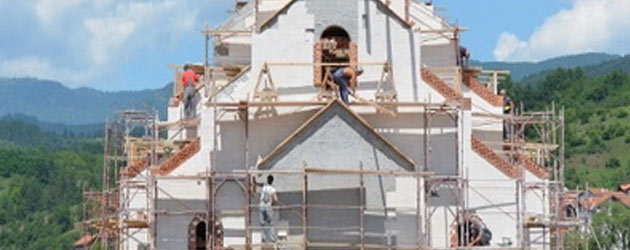
The foundations of the church, which is situated in the protruding portion of land at the mouth of the Rzav into the Drina at the far end of Andrićgrad, were laid on April 27, while the roof was made and the cross put up on it on June 25.
Only three days later, on Vidovdan (St Vitus’ Day), Bishop Grigorije of Zahum-Herzegovina served a divine liturgy inside the unfinished church.
Andrićgrad chief manager Žan Marjanović says the temple was built in record time but that this is no news at all, because all buildings in town were built like that and within two years more than 70% of the stone town came to life.
“I must say that the church was built by the people of Višegrad, the builders employed with Višegrad-based contractors of Andrićgrad, with the help of visionary ideas of professor Emir Kusturica, chief engineer Radomir Stojić and many others who took part in this and the remaining projects,” Marjanović told Srna.
The builders made sure that the temple was unique in all aspects, original also by the construction materials installed.
The façade is furnished with 1,000 square metres of special white travertine stone, dug out in a quarry at the Turkey-Syria border. Fireproof bricks, installed around windows and doors, were imported from Greece and are currently used in the Hilandar Monastery reconstruction.
Special glass absorbing negative effects of ultraviolet radiation has been installed in windows so that people can feel comfortable inside the temple during service.
Copper, which furnishes the dome, was prepared at the copper mill in Sevojno especially for the temple at Andrićgrad.
The most up-to-date construction materials, even eco-cement, were installed in the walls and foundations of the temple, the other buildings included. The church walls are approximately 50cm wide. Such and other methods allow 20% of energy to be saved.
There are plans that the iconostasis as well as the icons on it be made by the most prominent Russian and Serbian artists. “The church will be painted in a mosaic. The job will take at least two years and the many features of the interior will be similar to the temple on Mt Oplenac in Topola, the endowment of the Karađorđević family in Serbia,” says Marjanović.
Numerous donors and philanthropists have expressed interest in the continuation of final works on the Andrićgrad church, a modified copy of the temple in the Visoki Dečani Monastery.
Dragan Špinjo, who was born in the village of Stari Brod and now lives in Belgrade, donated the construction of the 2.2m cross with 22-carat gilded surface and special coating, which will preserve its shine and colour for centuries.
The temple in Andrićgrad is 19 metres tall, 26 metres long and 16 metres wide.
It has been planned to also build a medieval wall on the banks of the Drina and Rzav as part of Andrićgrad, but, according to Marjanović, there will be a slight deviation from the idea in order to allow the temple to be visible from three sides and shine in full glory at the sight of all those who pass down the Užice – Ustiprača main road.
“We haven’t planned to build the temple in this stage, but Kusturica insisted on it and he is very proud that the building has in such a short time become a jewel and pride of the town dedicated to Ivo Andrić,” says Marjanović.
It is expected that the holy object in Andrićgrad will be a cathedral church. Priest Milutin Andrić has already been appointed the head priest of the church.
Given that the construction materials used so far in the construction of Andrićgrad comply with globally recognised standards, the management say they will apply for an environmental certificate as well.
(Srna/Frontal)

