
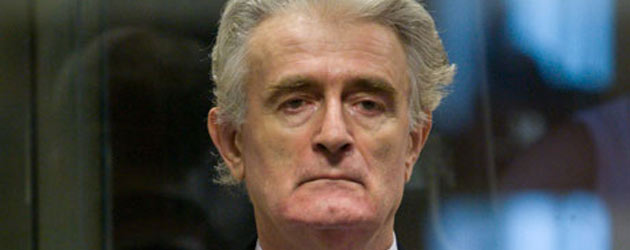
”I’m
not saying I’m not guilty, but that nobody is guilty, because there was
no genocide,” Karadžić said at the end of the hearing held upon the
complaint of the Prosecution, who asked that Count 1 which had charged
him with genocide in seven Bosnia and Herzegovina municipalities between
May and December of 1992, be introduced back in the indictment.
Karadžić said that during his life in politics, him being also a
doctor and a writer and not a politician, he had given hundreds of
interviews and statements and issued hundreds of documents and orders,
but that the Prosecution could not find any consistent paragraphs that
would identify genocidal intentions or intentions to commit any kind of
crime.
As for the speech he made on October 15, 1991 in the multi-national
Assembly of Bosnia and Herzegovina, the parts of which the prosecution
showed in the courtroom on Wednesday, Karadžić said it had been “an
unambiguously anti-war speech.”
In the footage that the Prosecution used, Karadžić said: “Don’t
think that you won’t lead Bosnia and Herzegovina to hell and the Muslim
people to disappearance, because the Muslims cannot defend themselves if
there is war here.”
During his presentation to the Appeals Chamber, Karadžić underlined
that in the speech, he had not persuaded the Muslims to go to war, but
advised them against it, and that the Serbs had considered the Croats to
be their enemies, not the Muslims.
”The Trial Chamber possesses plenty of evidence that the Serb side
which I led had done everything in its power to avoid the war. When the
war broke out, it broke out in the places where the opposite side wanted
it to. In most of the municipalities, there was neither war nor
violence. Entire settlements remained whole, even in places where there
were conflicts and crimes, there were some Muslims villages that did not
suffer any damage,” said Karadžić.
He submitted that the Serb side had made agreements with the
pro-European Muslim leaders and that it had given up on its plans in the
interest of preserving Yugoslavia.
Karadžić said that the ones who had committed crimes “were careful
that the boss wouldn’t find out,” and that “there were crimes, but the
government penalised them.”
”They can’t find any trace of genocidal intentions in thousands of
my speeches, interviews, and so on. Around 80% of the documents speak
about refraining from conflict, of ceasefire, and of the passage of
humanitarian aid convoys. Not a trace of genocidal intentions,” he said.
According to him, there is not a single document or norm that would
discriminate against the Muslims or Croats. “Even if it wasn’t so,
there’s no genocide on the ground, because the war was waged where the
other side wanted it, where battles were caused, that’s where there was
chaos,” said Karadžić.
The defendant’s chief legal advisor Peter Robinson called on the
Appeals Chamber to confirm the decision that in June of 2012 acquitted
Karadžić of charges of genocide in BiH municipalities. “There’s no
reason to amend the Trial Chamber decision,” said Robinson.
He said that when it filed the complaint, the Prosecution applied
wrong standards from the Tribunal’s Rules of Procedure and Evidence.
“The Prosecution does not object the fact that Karadžić was acquitted
but that he was acquitted too early,” Robinson said.
He added that in the period referred to in the indictment, the Serb
forces held prisoners, but released them later on. “They were held in
detention facilities which were controlled by the Serbs, but most of
them were released,” said Robinson and asked, “How come that 98% of them
didn’t manage to ‘escape’ the Serb forces, which were controlling 70%
of the territory at the time.”
He also said that “not only did the forces of Radovan Karadžić and
Ratko Mladić let the prisoners go, but also took care of the transport.”
(Srna/Frotnal)

